


Blog
Shadow AI is Already Inside Your Organization: What Leaders Must Do
Written by
Tim Tucker /  March 3, 2026


Summary
Shadow AI is no longer a visibility gap; it is a governance risk. As AI adoption accelerates, unmanaged use exposes data, compliance, and IP. This guide outlines how leaders can regain control through structured oversight and guardrails.
We’re back to Shadow AI, and it’s not something to take lightly.
Back in 2023, engineers at Samsung Electronics unintentionally uploaded sensitive semiconductor source code into ChatGPT. What appeared to be a harmless productivity shortcut quickly escalated into a global security incident.
It wasn’t malicious.
It wasn’t strategic.
It was convenient.
But here’s the reality: that wasn’t an isolated event. And it wasn’t the beginning.
Across industries, employees continue to use AI tools daily, often outside formal enterprise oversight. An IBM study found that 80% of the US workforce leverages AI tools in their roles, yet only 22% rely on subscriptions approved by their employers. That means the majority of AI usage is happening beyond structured governance.
While AI can boost productivity and efficiency, without proper governance, it can silently compromise data security, compliance, and operational visibility, making it a leadership priority.
First Things First—What is Shadow AI?
Shadow AI is associated with the usage of unsanctioned or unauthorized AI tools by employees without formal approval from the IT team, security oversights, or governance controls.
Unlike enterprise-deployed AI systems, Shadow AI operates outside defined policies and monitoring frameworks.
It may include:
- Employees using public generative AI tools for drafting, coding, analytics, or research
- Teams subscribing to AI SaaS platforms without procurement or security review
- Sensitive company data being uploaded into external AI systems
- AI-generated outputs influencing decisions without validation
When employees are under pressure to deliver faster results, AI tools become the shortcut. If leadership does not provide secure alternatives, adoption happens anyway in a quiet mode.
Why Shadow AI is Emerging: Key Drivers
The AI productivity tools market is set to grow from $8.8B in 2024 to $36.4B by 2033 showing how quickly these tools are entering everyday business workflows. This rapid adoption, combined with gaps in governance, skills, and productivity pressures, is creating the conditions for Shadow AI to emerge across enterprises.
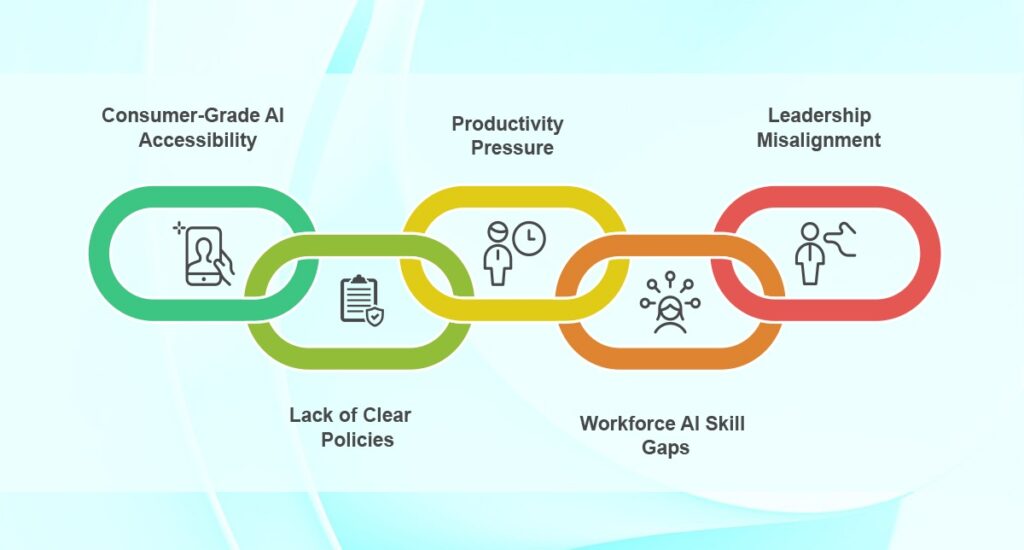
1. Consumer-Grade AI Accessibility
Easy-to-use AI tools encourage independent adoption, creating unsupervised use and potential Shadow AI risk.
2. Lack of Clear Policies
Without formal rules, employees are unsure of acceptable AI use, leading to unmonitored AI activity.
3. Productivity Pressure
Tight deadlines push employees to use AI tools without approvals, driving unregulated AI usage.
4. Workforce AI Skill Gaps
Limited AI literacy increases misuse of AI tools, contributing to uncontrolled or unsupervised AI activity.
5. Leadership Misalignment
Leaders expect AI-driven productivity but delay formal adoption and governance, pushing employees toward unofficial tools.
Why Ignoring Shadow AI Could Cost Your Organization
Traditional bans, such as blocking AI websites or issuing blanket restrictions, rarely work. Employees can still access tools through external networks or unsanctioned accounts, pushing AI use further into the shadows. And the risks compound across multiple layers
1. Data Leakage
When employees use unapproved AI tools, they may enter sensitive company information into external systems without visibility or control, which carries the risk of unintended use. As evidence suggests, 1 in 5 organizations (20%) experienced breaches linked to Shadow AI, increasing the average breach cost by up to USD 670K and disproportionately exposing customer PII and intellectual property.
Impact: Financial penalties, legal exposure, and loss of competitive advantage.
2. Compliance Violations
When sensitive data moves beyond governed systems, organizations may unknowingly breach industry regulations and internal controls. Consequently, unmanaged AI use can trigger conflicts with privacy laws, contractual commitments, and audit standards.
Impact: Regulatory fines, investigations, and operational disruption.
3. IP Exposure
When proprietary assets such as code, designs, and strategic plans may be shared with external AI platforms and leave controlled environments, it becomes difficult to trace, retract, or fully protect.
Impact: Loss of exclusivity, weakened market positioning, and long-term strategic risk.
4. AI Hallucinations
Even when no sensitive data is exposed, AI tools can generate inaccurate, biased, or fabricated outputs. These errors can influence business decisions, reports, or customer communications, adding operational and reputational risk.
Impact: Costly errors, rework, and reduced business reliability.
5. Reputational Damage
Over time, these risks compound. Security incidents, compliance failures, or public AI missteps can erode stakeholder confidence. As expectations around responsible AI rise, weak governance quickly turns into a credibility and trust issue.
Impact: Brand erosion, customer churn, and revenue impact.
How Organizations Can Manage Shadow AI Risks
To address Shadow AI risks, organizations can adapt various approaches to use AI responsibly.
1. Conduct an AI Exposure Audit
Start with visibility.
- Map AI usage across departments
- Identify unauthorized SaaS subscriptions
- Analyze data movement patterns
- Assess third-party integrations
It’s simple, you cannot govern what you cannot see.
2. Define a Clear AI Usage Policy
Clarity reduces shadow behavior.
Develop formal, organization-wide guidelines that clearly define:
- Approved AI tools
- Restricted or sensitive data categories
- Acceptable use cases
- Escalation and approval protocols
When expectations are explicit, employees are far less likely to operate outside policy boundaries.
3. Establish an AI Governance Council
Shadow AI governance requires cross-functional alignment at the leadership level.
Form a governance council that includes:
- CIO
- CISO
- Legal
- Compliance
- HR
- Business unit leaders
AI governance should sit within executive oversight, not remain isolated within IT. Strategic leadership ensures accountability, consistency, and responsible innovation.
4. Investment in AI infrastructure
As per IBM studies, 40% of employees choose external AI solutions. The reason is simple: more robust features. To complete this, companies need to invest in: Secure enterprise AI platforms such as Microsoft-powered ERP systems that:
- Centralized data environments
- Access controls and identity management
- Scalable cloud architecture
- Model monitoring and audit capabilities
Purpose-built AI infrastructure reduces reliance on unsanctioned tools and creates a controlled environment for innovation.
“Microsoft is investing over $80 billion in 2026 to develop global AI-enabled data center infrastructure.”
5. Provide Secure Enterprise Alternatives
Shadow AI declines when safe, sanctioned tools are easily accessible.
Organizations can reduce risk by:
- Accelerating procurement and security reviews
- Embedding AI within existing workflows
- Offering internal AI sandboxes for experimentation
- Ensuring tools are user-friendly and performance-ready
When employees are equipped with approved, high-performing tools, they naturally gravitate toward them.
6. Implement Continuous Monitoring and Guardrails
Monitoring is not surveillance; it is proactive risk management.
Deploy controls such as:
- Data Loss Prevention (DLP) systems
- Cloud Access Security Brokers (CASB)
- AI usage logging and analytics
- Regular risk audits and compliance checks
Continuous monitoring allows organizations to detect vulnerabilities before they escalate into incidents.
7. Invest in AI Literacy and Training
Technology alone cannot solve governance challenges.
Educate employees on:
- Responsible AI usage
- Data handling standards
- Bias and hallucination risks
- Ethical and regulatory considerations
An informed workforce strengthens compliance and reduces unintended exposure.
Final Thoughts
Shadow AI has evolved beyond a hypothetical IT concern. It is an operational and financial risk, especially in construction environments where bid data, labor costs, contracts, and job site documentation move rapidly across teams and partners. Ignoring it does not stop adoption; it simply pushes it beyond visibility and control.
With the right governance, guardrails, and leadership alignment, construction firms
can turn AI from a hidden liability into a competitive advantage.
Concerned about Shadow AI in your construction organization?
Stay tuned for our next blog!
FAQs
Shadow AI is the use of unsanctioned AI tools by employees without IT oversight, creating hidden security and compliance risks.
AI adoption is widespread, but enterprise visibility is limited, allowing unmanaged tools to operate outside governance controls.
Shadow AI is becoming increasingly common across industries. Many employees experiment with AI tools to improve productivity, often without informing IT or leadership. This creates visibility gaps where organizations are unaware of how and where data is being processed.
Shadow AI itself is not automatically illegal. However, it can create legal and compliance risks if confidential, personal, or regulated data is shared through unapproved AI platforms. The risk depends on how the tool is used and what data is involved.
Organizations detect unauthorized AI usage through network monitoring, SaaS discovery tools, endpoint management systems, browser activity insights, and Data Loss Prevention (DLP) solutions. Regular audits and AI governance policies also help improve visibility.
Companies can manage AI usage by:
- Defining a clear AI usage policy
- Providing approved AI tools for business tasks
- Training employees on data security risks
- Monitoring network and SaaS activity
- Establishing AI governance oversight
Control is more effective when guidance is proactive rather than restrictive.
While Shadow IT refers to unauthorized software or hardware used within an organization, Shadow AI specifically involves unsanctioned generative AI tools used for business tasks.
The key difference is data exposure risk. Generative AI tools often process prompts externally, which may include sensitive information. This introduces unique governance, privacy, and compliance challenges beyond traditional Shadow IT.
Yes. Shadow AI can create compliance risks under frameworks such as GDPR, HIPAA, and SOC 2 when sensitive data is processed outside approved systems.
Organizations operating in the U.S. and globally must ensure AI usage aligns with internal governance standards and regulatory obligations to avoid regulatory exposure and audit issues.
Categories
- Upgrade
- United States
- United Arab Emirates
- Retail
- Power BI
- Partner Program
- Migration
- Microsoft Dynamics 365 Finance and Operations
- Microsoft 365 Copilot
- job costing software for electrical contractors
- Industry Updates And Events
- Implementation
- Finance and Operations
- Dynamics SL
- Dynamics NAV
- Dynamics GP
- Dynamics Business Central
- Dynamics 365 for Sales
- Dynamics 365 Field Service
- Dynamics 365 Customer Service
- Dynamics 365
- CRM and ERP
- Construction365
- Cloud Migration
- Canada
- Australia
- Artificial Intelligence
- AI Agents in Business
Recent Posts
- Frontier Transformation in Retail: When AI Moves from Insight to Action
- AI Agents in Microsoft 365 Copilot: The Future of Intelligent Business Automation
- Price Hiked, Value Locked: The Guide to Business Central Pricing in Australia
- From Dispatch to Invoice in Minutes: The Business Central Field Service Integration Built for Serious Service Companies
- Top Business Central Features Middle East SMEs Are Using to Pull Ahead