

Blog
Tenant Copilot & Agent Factory: How Microsoft Is Redefining Enterprise AI Work
Written by
Tim Tucker /  February 26, 2026


AI Is Becoming an Administrative Reality – Not Just a User Feature
For the past two years, AI inside Microsoft 365 has largely been framed as a productivity enhancer.
Draft faster.
Summarize meetings.
Generate reports.
But something more structural is happening.
AI is no longer operating only at the user level. It is beginning to function at the tenant level—across shared knowledge, sensitive enterprise data, and cross-functional workflows. And that changes the conversation entirely.
The question is no longer: should we use AI? In most enterprises, that’s already decided. The real question would be how do we govern AI responsibly when it operates across the organization, not just for individual users?
This is where two emerging concepts in Microsoft’s AI direction become important: Microsoft Tenant Copilot and the Microsoft Agent Factory model. Together, they signal a shift from AI as a tool to AI as an enterprise system.
Tenant Copilot: Why AI Needs to Understand the Organization, Not Just the User
As organizations adopt Microsoft 365 Copilot enterprise AI capabilities, early benefits are clear. Individuals gain speed. Teams save time.
But individual productivity is only one layer of enterprise intelligence. In real organizations:
- Workflows across departments.
- Terminology differs between teams.
- Policies shape how information is accessed.
- Compliance boundaries influence decisions.
Tenant Copilot introduces a different direction.
Instead of treating Copilot as a collection of personal assistants, it points toward AI that understands the organization itself – how information is structured, which data boundaries matter, and how work flows across Microsoft 365.
What Tenant-level Intelligence Really Means
Tenant Copilot is less about adding another Copilot and more about changing what Copilot knows:
- It aligns AI responses with organizational language and terminology, not individual phrasing
- It respects tenant-wide data boundaries and policies, not just user access
- It grounds AI outputs in shared knowledge, rather than isolated documents
This shift moves AI from being personally helpful to organizationally reliable.
Why this matters for knowledge work
When AI operates with tenant-level understanding:
- Teams receive consistent answers, even when they ask questions differently
- Knowledge doesn’t reset when people change roles or teams
- Decision-making becomes faster because AI outputs require less validation
For knowledge workers, this reduces cognitive overhead. For organizations, it preserves institutional knowledge that would otherwise remain fragmented.
Why admins care about this shift
From an administrative perspective, Tenant Copilot creates something even more important: predictability.
- AI behavior becomes easier to govern
- Outputs align with organizational standards by design
- Compliance and policy considerations are built in, not retrofitted
Once AI understands the organization, it stops behaving like a personal tool and starts functioning as an enterprise capability.
And once AI reaches that point, expectations change again. Organizations don’t just want AI to explain; they want it to act. That’s the moment when AI agents enter the conversation.
The Coming Wave of AI Agents Inside Microsoft 365
Once AI begins to understand organizational context, expectations change quickly. Enterprises don’t just want AI to respond – they want it to act.
This is where AI agents start to enter everyday Microsoft 365 environments.
Unlike traditional AI interactions, agents are designed to work continuously, often in the background. They don’t wait for a prompt. Instead, they:
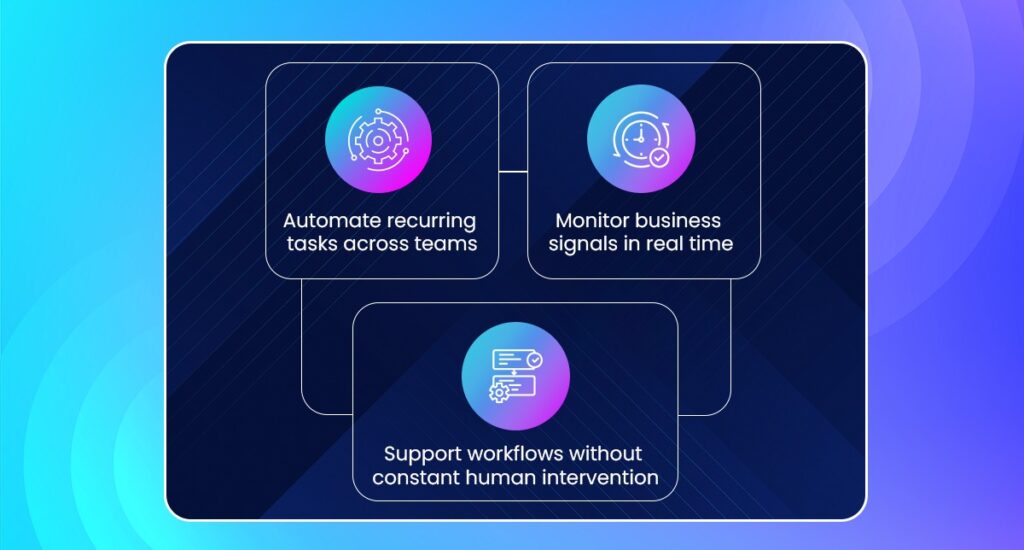
What makes AI agents fundamentally different is how they operate:
- They don’t log off at the end of a workday
- They don’t belong neatly to a single user
- Their actions can span multiple teams, apps, and data sources
At first, this feels like progress. Teams gain faster outcomes and reduce manual effort. But as more agents are created to solve local problems, complexity builds quietly.
Without clear structure, organizations begin to see early warning signs:
- Multiple agents interacting with the same data
- Limited visibility into what actions agents are taking
- Unclear ownership and accountability
This is the familiar pattern enterprises have seen before innovation moving faster than governance. And it raises a critical question that can’t be ignored:
How do you scale AI agents without losing control, visibility, and trust?

The Agent Factory Concept: How Organizations Prevent AI Agents from Turning into Chaos
The Microsoft Agent Factory is not simply about building AI agents.
It represents an operational model, a structured way to design, deploy, govern, monitor, and retire AI agents at enterprise scale. It introduces:
- Centralized agent oversight
- Defined creation permissions
- Data boundary controls
- Lifecycle management
- Audit visibility
- Clear ownership accountability
Why this matters for organizations
Without a shared approach, AI agents risk becoming the next version of shadow IT. Agent Factory pushes organizations to think about:
- Who can create AI agents
- What data those agents can access
- How their actions are monitored
- When agents should be updated or retired
This isn’t about slowing teams down. It’s about ensuring AI scales with clarity and trust, not confusion.
In simple terms:
- Tenant Copilot defines what AI understands
- Agent Factory defines how that intelligence is put to work safely
Together, they reflect Microsoft’s shift toward AI that can operate across the enterprise — without losing control or accountability.
Why Tenant Copilot and Agent Factory Point to a Broader Shift in Microsoft’s Enterprise AI Strategy
Viewed together, Tenant Copilot and Agent Factory show that Microsoft is no longer building AI just for productivity—it’s building AI to run at enterprise scale.
Tenant Copilot is about understanding: it grounds AI in organizational context, shared knowledge, and tenant-wide standards instead of disconnected, user-level prompts. Agent Factory is about execution: it brings structure to how AI agents are created, governed, and trusted as they operate across teams.
The real shift is in combination. AI is moving from “a helpful tool” to part of the system your business runs on. For leadership, that changes the evaluation lens from “Where can AI boost productivity?” to questions like:
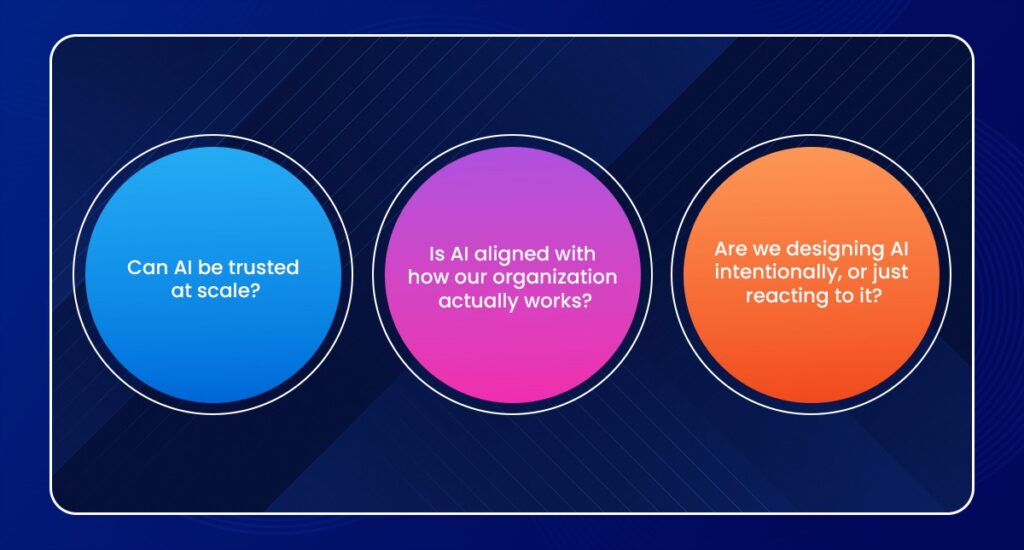
The next phase of enterprise AI will reward organizations that focus on structure, governance, and readiness—not just feature adoption.
Read more: Dawn of Agentization in Dynamics 365 and Beyond with Microsoft Copilot
How DynamicsSmartz Helps Enterprises Turn Microsoft’s AI Vision Into Reality
Understanding Microsoft’s direction around Tenant Copilot and Agent Factory is an important first step. Acting on it, however, is where most organizations struggle. AI at this level isn’t something that can be “switched on”; it needs to be designed, governed, and integrated into existing Microsoft 365 environments with care.
This is where DynamicsSmartz, as a Microsoft Solutions Partner and Microsoft services provider, plays a critical role. We help enterprises move beyond AI experimentation by aligning Microsoft’s AI capabilities with real organizational needs from tenant-level readiness to governance, security, and long-term scalability.
Our approach focuses on helping organizations:
- Prepare their Microsoft 365 tenant for AI that operates across teams and workloads
- Design governance frameworks that support AI agents without slowing innovation
- Align AI adoption with organizational change, compliance, and security requirements
- Translate Microsoft’s evolving AI roadmap into practical, business-ready outcomes
Rather than reacting to AI after it’s already embedded in daily work, we work with organizations to plan AI adoption intentionally ensuring trust, visibility, and control as AI becomes part of how work gets done.
As Microsoft consistently leads the evolution of enterprise technology and AI, organizations that partner early with experienced Microsoft service providers will be better positioned to adopt AI confidently, not reactively.

Categories
- Upgrade
- United States
- United Arab Emirates
- Retail
- Power BI
- Partner Program
- Migration
- Microsoft Dynamics 365 Finance and Operations
- Microsoft 365 Copilot
- job costing software for electrical contractors
- Industry Updates And Events
- Implementation
- Finance and Operations
- Dynamics SL
- Dynamics NAV
- Dynamics GP
- Dynamics Business Central
- Dynamics 365 for Sales
- Dynamics 365 Field Service
- Dynamics 365 Customer Service
- Dynamics 365
- CRM and ERP
- Construction365
- Cloud Migration
- Canada
- Australia
- Artificial Intelligence
- AI Agents in Business
Recent Posts
- Frontier Transformation in Retail: When AI Moves from Insight to Action
- AI Agents in Microsoft 365 Copilot: The Future of Intelligent Business Automation
- Price Hiked, Value Locked: The Guide to Business Central Pricing in Australia
- From Dispatch to Invoice in Minutes: The Business Central Field Service Integration Built for Serious Service Companies
- Top Business Central Features Middle East SMEs Are Using to Pull Ahead