

Blog
The 2026 CIO Roadmap: Cloud ERP TCO in UAE and When to Modernize NAV/GP
Written by
Vinay Punjabi /  January 13, 2026


In boardrooms across United Arab Emirates, a familiar question is surfacing with increasing urgency: “Is our ERP still helping us grow—or quietly holding us back?”
For CIOs and CFOs in Dubai, Abu Dhabi, and across the GCC, 2026 represents a tipping point. Legacy ERP platforms like Microsoft Dynamics NAV and GP—once dependable workhorses—are now struggling to keep pace with modern expectations around agility, compliance, analytics, and cost efficiency.
Governments across the region are accelerating digital mandates. VAT frameworks are evolving. Cybersecurity scrutiny is intensifying. At the same time, business leaders are under pressure to reduce Total Cost of Ownership (TCO) while enabling faster, data-driven decision-making.
This is where cloud ERP, and specifically Dynamics 365 Business Central, enters the conversation.
This roadmap is designed to help leadership teams in the UAE and Dubai ERP markets understand:
- Why cloud ERP software MENA adoption is accelerating
- How TCO fundamentally changes in the cloud
- When legacy NAV/GP modernization becomes unavoidable
- And how to lead a successful migration with confidence in 2026
2026 IT Spend & Cloud ERP Adoption Trends
MENA is no longer “catching up” digitally—it’s leapfrogging.
Regional analysts estimate that IT spending in MENA will surpass $165 billion by 2026, with double-digit growth in cloud platforms, AI-driven software, and enterprise SaaS. A growing share of that spend is flowing into ERP software, particularly cloud ERP solutions UAE businesses can deploy faster and scale more predictably.
What’s Driving Cloud ERP Adoption in 2026?
Several structural forces are converging:
- Cloud-first government initiatives in the UAE and Saudi Arabia
- Rising demand for real-time financial visibility from CFOs
- Greater need for localization, compliance, VAT, and statutory readiness
- End-to-end mobility and remote-first ERP operations
- A shift from CapEx-heavy IT models to subscription-based cloud business software
Cloud ERP is quickly becoming the default model for businesses seeking scalability, faster deployment, and operational efficiency.
Understanding TCO: Cloud ERP vs. Legacy NAV/GP
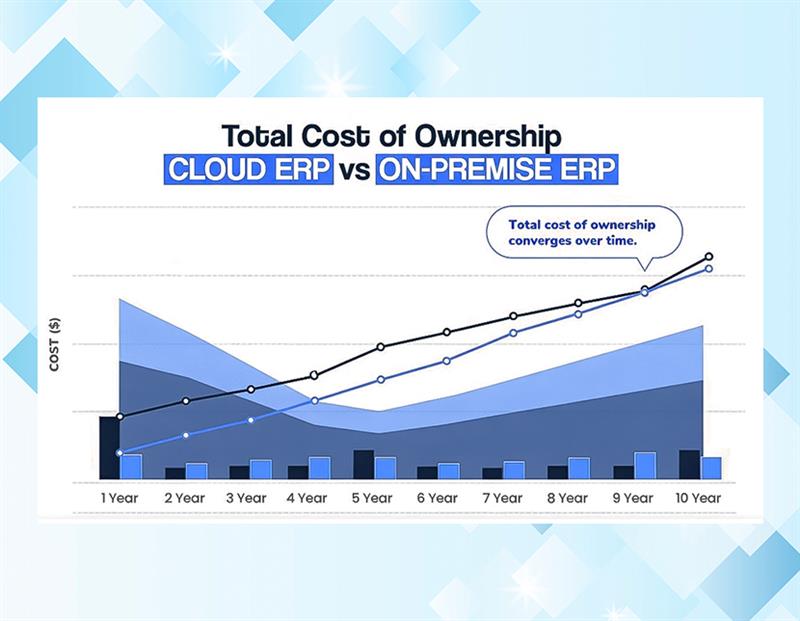
If there’s one lens CIOs and CFOs agree on, it’s this: TCO tells the real story.
First Things First—What TCO Really Means for ERP
Total Cost of Ownership is just not related to licensing. It includes:
- Infrastructure and hardware
- Upgrade and customization costs
- Downtime and performance risk
- Security, compliance, and disaster recovery
- Internal IT effort and opportunity cost
When viewed holistically, legacy ERP systems often appear cheaper, until you add what’s hidden.
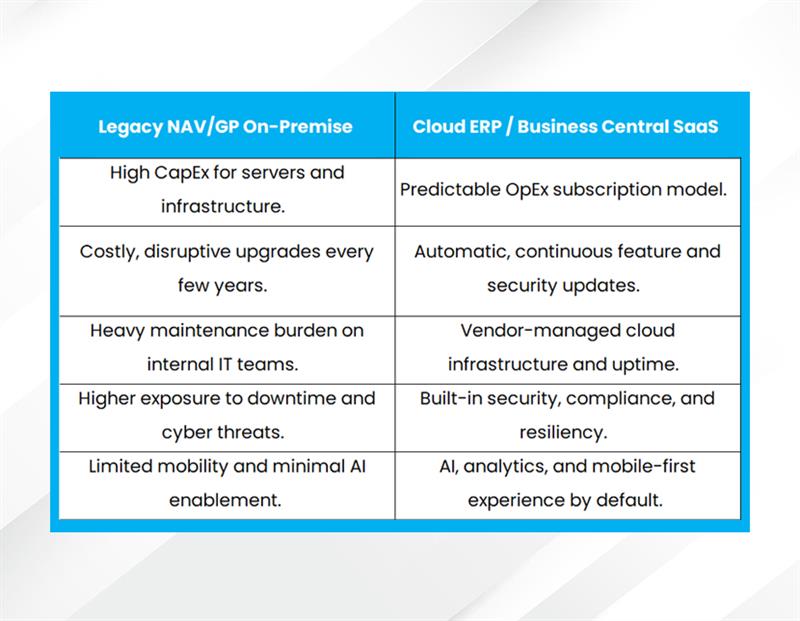
For many ERP for small business and mid-market enterprises, the numbers are compelling. Over a 5-year horizon, MENA is projected to reach $17.2B by 2030, growing at over 20% CAGR, signaling a clear enterprise shift toward cloud-first operating models.
When to Modernize: Key Triggers for NAV/GP Migration
ERP modernization rarely starts with IT. It starts with business friction.
Common Signals It’s Time to Move
- Integrations are brittle or expensive
- Reporting relies heavily on spreadsheets
- Remote and mobile access is limited
- Compliance updates require custom work
- Key ERP talent is difficult to retain
- Vendor support timelines are tightening
In the ERP UAE context, regulatory complexity adds urgency. VAT rules, audit readiness, and data residency expectations are evolving faster than legacy platforms can easily support.
Industry-Specific Pressure Points
- Manufacturing software for small business: demand planning, inventory accuracy, production visibility
- Construction ERP software: project costing, cash-flow forecasting, multi-entity reporting
- Retail & distribution: omnichannel visibility, pricing agility, real-time margins
In each case, cloud-based ERP solutions offer flexibility legacy systems to struggle to match.
The 2026 Modernization Roadmap: A Leadership Playbook
CIOs and CFOs driving ERP modernization in UAE, especially in Dubai should approach the journey as a strategic transformation, that includes:
Phase 1: Assess & Align
- Map current ERP usage and integrations
- Identify business bottlenecks and risks
- Establish executive sponsorship across IT and Finance
Phase 2: Build the Business Case
- Model true ERP TCO (current vs. cloud)
- Define success metrics beyond cost (speed, insight, scalability)
- Align ERP goals to growth and compliance strategy
Phase 3: Migrate with Confidence
- Adopt a phased migration approach
- Prioritize data quality and security
- Test extensively with real business scenarios
Phase 4: Optimize & Innovate
- Track KPIs post-go-live
- Enable analytics, automation, and AI features
- Continuously refine processes
- This approach minimizes risk while ensuring that the ERP transformation delivers measurable value.
Case Study: A Manufacturing Modernization Success in MENA
A regional manufacturing organization operating across the GCC faced growing challenges with Microsoft Dynamics NAV. Sales visibility was limited, reporting cycles were slow, and CRM integration required manual workarounds.
The Transformation
Scope
- Migrated from NAV to Dynamics 365 Business Central
- Integrated CRM and third-party tools
- Implemented executive dashboards
- Rolled out in controlled phases
Business Impact
- Faster sales forecasting and pipeline clarity
- Improved cross-department efficiency
- Leadership gained real-time financial insight
- ERP platform scaled effortlessly with expansion plan
The key takeaway? ERP modernization succeeds when process discovery, stakeholder alignment, and regional expertise come together.
Conclusion: Your Leadership Window Is Now
For CIOs and CFOs across Business Central UAE and Business Central Dubai markets, 2026 is not about whether ERP modernization will happen, but when and how well.
Organizations that act now will benefit from:
- Lower long-term ERP software TCO
- Greater operational agility
- Stronger compliance and security
- A future-ready ERP foundation
Those who delay risk rising costs, growing complexity, and lost competitive ground.
At DynamicsSmartz, we help leadership teams navigate this transition with clarity and confidence. If you’re evaluating ERP software, considering cloud accounting software, or planning a move from legacy systems, now is the time to start the conversation.
Request a no-cost TCO analysis or a 1:1 modernization roadmap session today.
Categories
- Upgrade
- United States
- United Arab Emirates
- Retail
- Power BI
- Partner Program
- Migration
- Microsoft Dynamics 365 Finance and Operations
- Microsoft 365 Copilot
- job costing software for electrical contractors
- Industry Updates And Events
- Implementation
- Finance and Operations
- Dynamics SL
- Dynamics NAV
- Dynamics GP
- Dynamics Business Central
- Dynamics 365 for Sales
- Dynamics 365 Field Service
- Dynamics 365 Customer Service
- Dynamics 365
- CRM and ERP
- Construction365
- Cloud Migration
- Canada
- Australia
- Artificial Intelligence
- AI Agents in Business
Recent Posts
- Frontier Transformation in Retail: When AI Moves from Insight to Action
- AI Agents in Microsoft 365 Copilot: The Future of Intelligent Business Automation
- Price Hiked, Value Locked: The Guide to Business Central Pricing in Australia
- From Dispatch to Invoice in Minutes: The Business Central Field Service Integration Built for Serious Service Companies
- Top Business Central Features Middle East SMEs Are Using to Pull Ahead