

Blog
Business Central vs. Xero: The 2026 Decision Guide for Australian Businesses
Written by
Nipun Thakur /  May 6, 2026


Summary
Choosing between Microsoft Dynamics 365 Business Central and Xero is not just a software decision. This blog explains how it is a choice between managing current operations and enabling future growth, focusing on scalability, costs, compliance, and long-term fit for Australian SMEs.
Let’s be direct about what this decision is.
When you’re a CFO, CEO, or Operations Director at an Australian SME evaluating a new accounting or ERP platform, it rarely feels like a software decision. It feels like a risk decision: what happens if you choose wrong, what switching will actually cost, and how long the business can afford to wait.
Here’s the reframe that matters. Business Central vs. Xero is not a comparison between two accounting tools. It is a choice between two growth paths. Xero helps you manage where your business is today. Business Central is built to support where it is going.
If your organisation has 20 to 500 employees and your current systems are starting to slow things down, reporting takes too long, and workarounds have become the workflow, then cracks are already forming. At that point, the decision stops being optional.
This comparison focuses on what actually drives the outcome: scalability, total cost of ownership, Australian compliance, integration depth, and long-term strategic fit. The best accounting software for Australian SMEs is not the one with the most features. It is the one that matches where your business is heading, not just where it stands today.
Let’s find yours.
What Are We Actually Comparing? (Defining the Playing Field)
Most Business Central vs Xero comparisons miss a critical point. These are not two versions of the same thing. It is like comparing a commercial kitchen to a microwave. Both serve a purpose. Only one is built to run operations at scale.
What is Microsoft Dynamics 365 Business Central?
Business Central is an ERP platform for growing businesses that have outgrown standalone accounting software. It connects finance, inventory, purchasing, sales, and operations in one system. Built within the Microsoft ecosystem, it integrates with Microsoft 365, Power BI, and automation tools and runs on Azure for security and scalability. It is designed for organisations where complexity is increasing, and systems need to catch up.
What is Xero?
Xero is cloud accounting software, widely used by small businesses across Australia and New Zealand. It excels at invoicing, bank reconciliation, and compliance. For single-entity businesses with straightforward financials, it delivers exactly what is needed. Its scope, however, is accounting, not operations.
Why This Distinction Matters
This decision ultimately hinges on the intent behind it. Improve financial tracking or implement a platform to run and scale the business. The right choice depends on where the business is heading, not just where it is today.
Microsoft Business Central vs. Xero: A Side-by-Side Comparison
| Capability | Microsoft D365 Business Central | Xero |
|---|---|---|
| Core Accounting | Strong | Strong |
| Inventory Management | Advanced (multi-location, serial/batch tracking) | Basic (cap: 4,000 items) |
| Multi-Entity / Consolidation | Native multi-entity & consolidated reporting | Requires a separate subscription per entity |
| Project / Job Costing | Native, across all operations | Established plan only |
| CRM Integration | Native Dynamics 365 CRM integration | Third-party (HubSpot, Salesforce) |
| AI / Copilot Features | Microsoft Copilot & AI Agents built in | Limited automation |
| ATO / BAS Compliance | Strong (with AU localisation) | Strong |
| API Call Limit | No practical limit | 5,000/day (peak risk) |
| Microsoft 365 Integration | Native (Outlook, Teams, Excel) | Third-party |
| Scalability | Mid-market to enterprise | Single-entity SME |
| Implementation Complexity | Medium-High (partner recommended) | Low |
Financial Management & Reporting
Xero handles core accounting well. But once reporting becomes multi-dimensional, across cost centres, entities, or real-time views, it starts to depend on add-ons and manual workarounds.
Business Central removes that layer, delivering real-time, consolidated reporting natively. For finance leaders, this is often where the shift becomes unavoidable.
Inventory & Supply Chain
Xero’s inventory works for simple use cases. It does not scale well into multi-location, high-volume, or supply chain-driven operations.
Business Central manages inventory, purchasing, and supply chain in one system, reducing reconciliation effort and operational blind spots.
Multi-Entity & Growth Complexity
Xero fragments as businesses expand. Each entity requires a separate subscription, with no native consolidation.
Business Central is built for this structure, handling intercompany transactions and multi-entity reporting without manual intervention.
AI, Automation & Ecosystem
Xero offers rules-based automation. Business Central embeds automation across the Microsoft ecosystem, combining Copilot, Power BI, and workflow tools. The difference is not capability. It is how deeply automation is integrated into daily operations.
Australian Compliance
Both platforms meet BAS and STP requirements. The decision is not about compliance. It is about what sits beyond it: basic financial tracking or full operational control.
The Real Cost of Staying on Xero: A Total Cost of Ownership View
Xero initially appears to be a cost-effective solution. For many businesses, it is. But most growing SMEs do not use Xero in isolation.
As operations expand, additional tools are introduced to fill functional gaps, such as project management software, customer relationship management systems, and inventory tracking solutions. Over time, what starts as a simple accounting system becomes a stack of disconnected applications.
The Hidden Cost of the Add-On Stack
A typical mid-sized Australian SME using Xero may rely on:
- Inventory tools for multi-location tracking and stock control
- CRM systems to align sales and finance
- Reporting tools for board-level visibility
- Project or job costing tools to manage operations
- Payroll upgrades to support workforce growth
Individually, each tool solves a problem. Collectively, they introduce the following:
- Multiple subscriptions and rising monthly costs
- Data silos across systems
- Manual reconciliation between tools
- Delayed or inconsistent reporting
In many cases, this stack reaches AUD 800 to AUD 2,000+ per month. At that point, the cost is no longer just financial. It is structural.
The Cost of Switching Late
- Data migration becomes more complex as transaction volumes grow
- Operational disruption increases with team size and dependencies
- Decision-making slows down due to fragmented, non-real-time data
Over time, the question shifts from whether the business can afford to move to what it is costing by staying where it is.
Business Central Pricing (Australia)
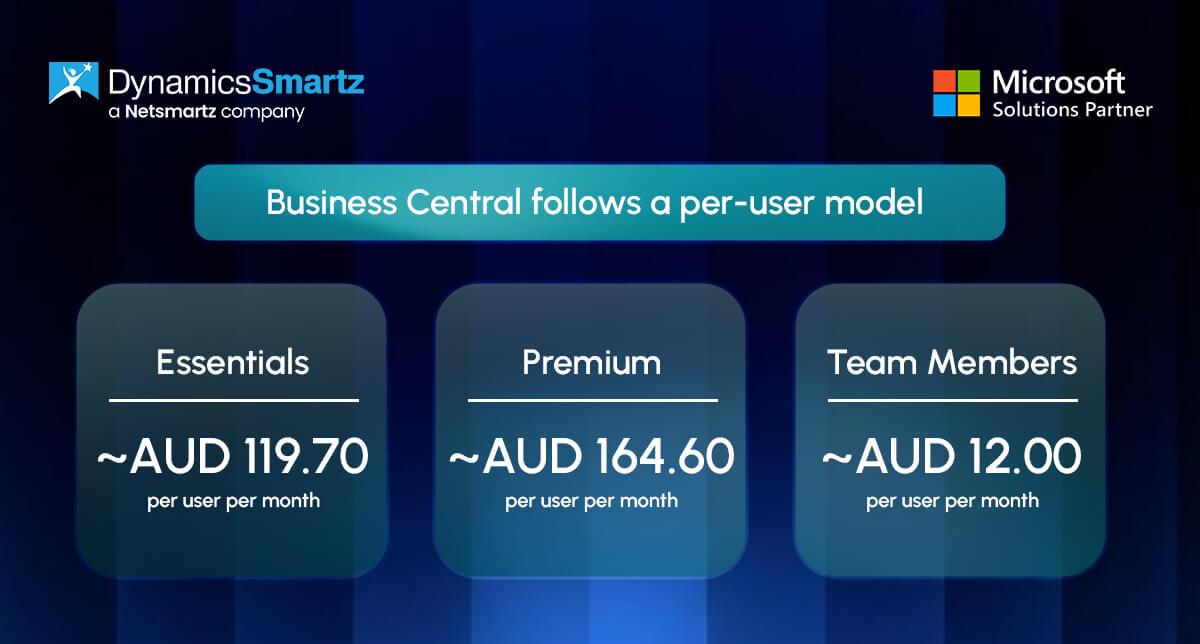
Disclaimer: Pricing varies based on licensing structure and implementation scope, typically through a Microsoft partner.
7 Signs Your Business Has Outgrown Xero
Growth doesn’t break a system overnight. It shows up in small friction points that start compounding.
Does any of this sound familiar?
- Running more than one entity?
Each one sits in a separate subscription, and consolidation becomes manual and time-consuming. - Inventory getting harder to track?
As SKUs or locations grow, visibility drops and errors start creeping in. - Relying on spreadsheets more than expected?
Reporting and consolidation depend on manual work, increasing risk and delays, which can lead to inaccurate data and hinder decision-making processes. - Adding more tools just to keep things running?
Systems start to disconnect, and data stops lining up cleanly. - Processes slowing down as the business grows?
Month-end close and reporting cycles take longer, not shorter. - Struggling to get a real-time view of the business?
Decisions are made on partial or outdated information. - Planning expansion but unsure if systems will keep up?
Growth starts to feel like a systems constraint, not a business opportunity.
Who Should Stay on Xero?
Xero is the right choice if the business is still relatively simple:
- Single-entity operations with straightforward financials
- Under 20 employees, with limited operational complexity
- Minimal inventory or no multi-location requirements
- Primary need is accounting, not operational management
- No major expansion planned in the near term
The risk lies in not choosing Xero. But it lies in continuing to use Xero after the business has outgrown it.
Migrating from Xero to Business Central: What to Expect
Most businesses do not plan a migration. They reach a point where staying becomes more difficult than moving.
Common triggers include:
- Operational bottlenecks that start eroding margins and slowing execution
- Delayed or manual financial reporting can limit visibility and slow down decision-making
- Inventory or supply chain errors that impact customer experience and revenue
- Expansion across entities or regions that current systems struggle to support
- Increased pressure from leadership or investors for timely, reliable insights
Once that point is reached, the transition typically follows a structured path:
- Discovery and scoping: understanding processes and data
- Configuration and migration: setting up the system and moving key data
- Testing and training: preparing teams and validating workflows
- Go-live and stabilisation: transitioning with support in place
For a mid-sized Australian SME, the transition usually takes 4 to 8 months, depending on complexity.
The timeline is important, but so is timing. Making the move at the right stage helps avoid unnecessary disruption and keeps operations running smoothly as the business grows.
Final Thoughts
The Business Central vs Xero decision is not about features. It is about fit. Xero remains a strong option for businesses with simple, single-entity needs. But as complexity grows, its limitations become harder to ignore. For organisations evaluating a Xero alternative for growing businesses in Australia, Business Central offers a more connected, scalable foundation.
The right choice depends on where the business is heading. Selecting a system aligned with that direction helps avoid costly transitions and ensures technology can support growth over the long term.
FAQs
It depends on where your business is today and where it is heading. In this Business Central vs Xero decision, Xero works well for simple, single-entity businesses. Business Central is better suited for organisations dealing with multiple entities, inventory, or rapid growth. This Microsoft Business Central vs Xero comparison helps clarify which system aligns with your current needs and future plans.
The best accounting software for Australian SMEs depends on complexity. Xero is a strong choice for small businesses with straightforward financials. For growing organisations that need more than accounting, Business Central stands out as a leading Xero alternative for growing businesses in Australia.
Yes, Business Central is fully localised for Australia. It supports BAS, GST reporting, Single Touch Payroll, and ATO compliance. With the right setup, it can meet both standard and more complex regulatory requirements.
Business Central pricing in Australia is typically ~AUD 119.70 per user/month for Essentials and ~AUD 164.60 for Premium, with Team Members at ~AUD 12.00 per user/month. Pricing is per user and scales with functionality, unlike fixed plan-based tools like Xero. A Microsoft Solutions Partner can provide a more accurate estimate based on your business needs.
Yes, migration is a standard process. Key data such as chart of accounts, customer and vendor records, open balances, and inventory can be transferred. A well-planned approach, usually over 4 to 8 months, ensures a smooth transition.
As businesses scale, common challenges include limited inventory handling, lack of native multi-entity consolidation, reliance on add-ons, and restricted real-time reporting. These gaps often lead businesses to explore a Xero alternative for growing businesses in Australia.
Yes, Business Central is widely used in construction and project-based industries. It supports job costing, project tracking, resource planning, and procurement. These are areas where Xero typically relies on third-party tools.
Categories
- Implementation
- Dynamics Business Central
- Dynamics 365
- Construction365
- Australia
- Artificial Intelligence
- AI Agents in Business
Recent Posts
- AI Agents in Microsoft 365 Copilot: The Future of Intelligent Business Automation
- Price Hiked, Value Locked: The Guide to Business Central Pricing in Australia
- Stop Paying the “On-Prem Tax”: Why Australian SMEs are Pivoting to Business Central SaaS in 2026
- Business Central vs. Xero: The 2026 Decision Guide for Australian Businesses
- Wasting Millions on “Fake” AI: The 2026 Australian Construction Reality Check