

Blog
A Practical Roadmap for Australia SMEs to Succeed with Dynamics 365 Business Central
Written by
Nipun Thakur /  December 9, 2025


According to a 2024 IDC report, over 68% of ANZ SMEs plan to invest in cloud-based ERP systems by 2026, with Dynamics 365 Business Central leading adoption due to its modular design, native Microsoft integration, and scalability
Across Australia and New Zealand, small and mid-sized businesses are entering a defining moment. Around 91% of ANZ SMEs expect revenue growth this year, yet many face rising labor costs, up 4.5% year-on-year, and ongoing supply-chain volatility. At the same time, three in four Australian SMEs plan to increase their cloud investments in 2026, aiming to work smarter, not just harder.
For many of these businesses, Dynamics 365 Business Central has become the logical next step—a single, cloud-based ERP that fits the unique realities of ANZ SMEs. But success depends on more than choosing the right system; it’s about getting the implementation right.
In this blog post, we’ll explore how ANZ SMEs can successfully implement Dynamics 365 Business Central, what Business Central benefits ANZ organizations are realizing, and how to align people, processes, and technology for measurable outcomes in 2026 and beyond.
Why Now is the Right Time for ANZ SMEs to Act
SMEs make up a huge portion of the business landscape in Australia (98% of businesses are small according to one local article),and the region is showing strong resilience. At the same time:
- Cloud solutions are expected to dominate. Amarket report suggests that 75 % of Australian SMEs are projected to use cloud-based solutions in the near future.
- According to another source, the Australian ERP market is growing, with strong internet penetration (96 % in 2023),enabling cloud-first strategies.
- A 2025 review of ERP in Australia warned that many SMEs still run on legacy systems, miss out on digital productivity gains, and face hidden costs.
The Case for Modern ERP and Cloud-Based Platforms
When organizations move from fragmented spreadsheets, disconnected systems, and manual processes to a unified ERP platform, the potential gains are meaningful: better visibility, faster decision-making, lower risk, and improved scalability. For the modern ANZ SME, the pressures are real: high labor costs, regulatory compliance, remote/hybrid teams, supply-chain complexity.
And for a platform like Dynamics 365 Business Central, the value proposition is especially compelling:
- Built for SMEs: subscription-based pricing, cloud deployment, and less upfront infrastructure burden.
- Integration with familiar Microsoft tools (Outlook, Excel, Teams) that reduces learning-curve friction.
- Embedded analytics, real-time dashboards, and stronger operational visibility, helping leaders make smarter decisions.
So, for ANZ SMEs that want not just incremental improvement, but a step change in how they operate, now is the time to consider how Dynamics 365 Business Central fits into their growth strategy.
What Are the Key Benefits of Business Central for ANZ SMEs
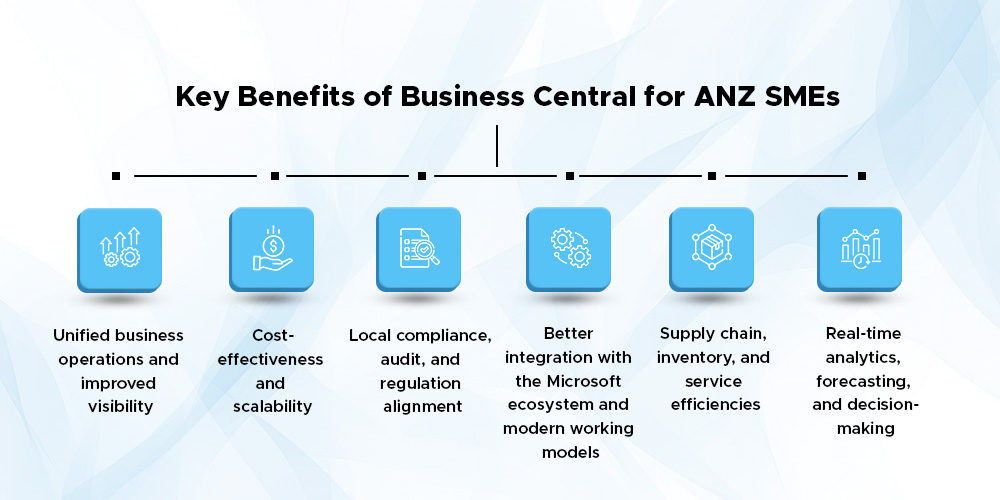
When thinking about ERP for ANZ SMEs, it helps to break down the benefits into real-world outcomes, rather than just features. Here are some of the most important benefits (and how they matter for this region):
1. Unified business operations and improved visibility
Dynamics 365 Business Central enables SMEs to unify finance, sales, procurement, inventory, projects, and service into one platform. This reduces data silos and minimizes duplication.
For ANZ SMEs, that matters because:
- It gives owners and leadership teams one “single source of truth” rather than multiple spreadsheets and disconnected systems.
- It enables faster and more confident decisions—for example, real-time cash-flow visibility, inventory levels, and order backlog.
- It helps track performance across multiple locations or remote/hybrid teams (which are increasingly common).
2. Cost-effectiveness and scalability
One of the key challenges for SMEs is balancing budget pressure with growth aspirations. The subscription-based cloud model of Dynamics 365 Business Central helps reduce upfront investment.
Meanwhile, in a Forrester-commissioned study, companies using Business Central saw a 162% ROI over three years (in one composite case) and significant cost avoidance.
- SMEs often operate in high labor-cost environments and need to automate processes rather than scale head count.
- Cloud scalability means they can add new users, modules, or locations without major infrastructure investment.
- Because of the high internet adoption in Australia (96% in 2023), cloud ERP is feasible across metro and regional areas.
3. Local compliance, audit, and regulation alignment
Australian and New Zealand SMEs face local regulation: GST/BAS, payroll (e.g., Single Touch Payroll in Australia), data privacy laws, and mobile/hybrid workforce compliance. One article specifically emphasizes that ERP systems must account for Australian rules.
Dynamics 365 Business Central (when implemented with local understanding) enables:
- Automated processes for GST, BAS lodgments, and payroll integration.
- Audit trails and reporting that align with local requirements.
- The flexibility to support remote teams and multiple sites across Australia & New Zealand.
4. Better integration with the Microsoft ecosystem and modern working models
Many ANZ SMEs already use Microsoft 365 tools — Outlook, Teams, and Excel. The seamless integration of Dynamics 365 Business Central means that introducing the ERP doesn’t feel like yet another tool for staff to learn.
Especially in 2026 and beyond, when hybrid working, remote access, mobile devices, and collaboration tools are central, this integration means:
- Grab productivity benefits quickly, which accelerates adoption and reduces resistance.
- Leverage familiar UI so the learning curve is smoother.
5. Supply chain, inventory,and service efficiencies
For product-based SMEs (manufacturing, wholesale, distribution) in the ANZ region, managing stock, lead times, warehouse movements, and service contracts is increasingly challenging. The platform supports inventory tracking, warehouse operations, recurring orders, and blanket contracts.
This means:
- Reduced risk of stockouts or overstock.
- Better service delivery and customer fulfillment reliability (which is a differentiator in Australia’s competitive market).
- Improved cost control across the supply-chain and operations.
6. Real-time analytics, forecasting, and decision-making
In a volatile environment, leaders want more than past data — they want insights, forecasts, scenario planning. Dynamics 365 Business Central offers built-in analytics, dashboards, and the ability to pull data into Power BI.
- Real-time visibility means quicker response to market changes (for example, inflation pressures, supply-chain disruption, changing customer behavior).
- Forecasting cash flow becomes more reliable.
- With the integrated Microsoft ecosystem, self-service analytics become accessible even for smaller teams.
How ANZ SMEs Can Successfully Implement Dynamics 365 Business Central
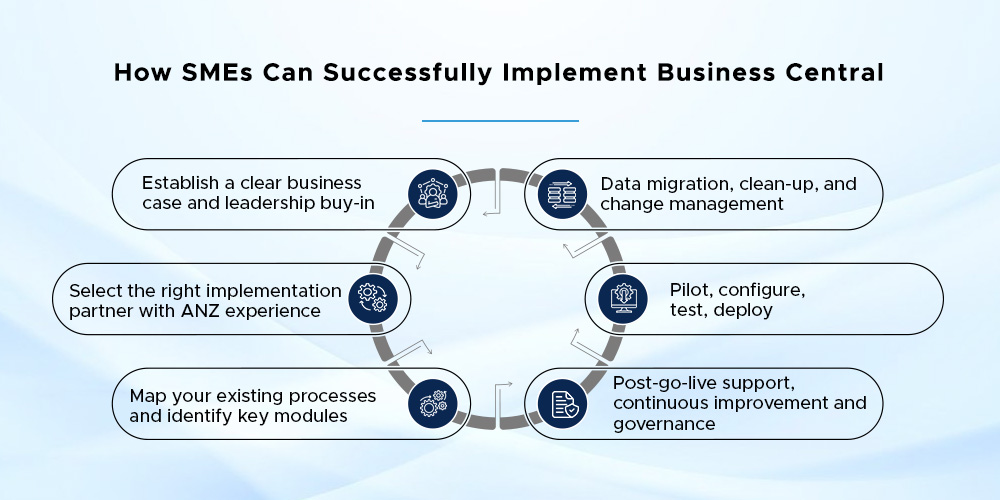
Implementation is where many good intentions falter. For ANZ SMEs, success depends on thoughtful preparation, local alignment, and change management. Here’s a step-by-step approach with practical tips.
Step 1: Establish a clear business case and leadership buy-in
Start with why — what specific pain points are you solving? For example: reducing manual reconciliations, integrating separate finance & operations systems, enabling remote work, and improving cash-flow visibility.
Important: Leadership must be engaged from the outset. One study found that a lack of top management commitment is a key barrier in SME ERP projects.
Tip: Present a realistic ROI model model, for example, referencing the Forrester case where Business Central achieved 162 % ROI over three years.
Step 2: Select the right implementation partner with ANZ experience
Because of local compliance, payroll rules, GST/BAS and hybrid working models, an ERP partner with ANZ experience is important. One article notes that Australian businesses are choosing Business Central because local partners help overcome legacy systems, remote-work needs and costing issues.
Tip: Ask for ANZ-specific experience: Have they done migrations for Australian SMEs? Do they understand Single Touch Payroll, ATO integrations, and multi-state operations?
Step 3: Map your existing processes and identify key modules
Before jumping into configuration, map what you currently do: finance, inventory, procurement, sales, service. Identify what works, what doesn’t, and where you need improvement. One article noted that many Australian SMEs only use 40–60 % of the features in their ERP — meaning unused modules represent wasted cost.
Tip: Focus on the features that will deliver value for your business now, and build a road map for later modules rather than trying to do everything at once.
Step 4: Data migration, clean-up, and change management
Data migration is often one of the most underestimated tasks. Articles on Australian SME ERP stress the hidden costs: cleaning legacy data, down time, and training.
Tip:
- Allocate sufficient time and budget.
- Engage your team in what data gets migrated; don’t carry forward irrelevant or duplicate data.
- Use this as an opportunity to rationalize your KPIs and reporting.
- Invest in training and change management; the best technology still fails if people revert to old ways.
Step 5: Pilot, configure, test, deploy
Rather than a “big bang” approach, many SMEs benefit from a phased roll-out: pilot key modules, test with a limited group, gather feedback, refine, then roll out more broadly.
Tip:
- Configure your workflows to match how your business operates; avoid forcing your business to fit the software (unless you’re intentionally re-engineering for improvement).
- Ensure integrations (e.g., CRM, payroll, e-commerce, POS) are working properly.
- Define what success looks like early (e.g., reduced month-end close time, increased visibility of cash-flow, elimination of spreadsheets).
Step 6: Post-go-live support, continuous improvement and governance
Go-live isn’t the end —it’s the beginning of a journey. A strong support model is critical to keeping momentum and securing ROI.
Tip:
- Monitor user adoption and identify “super-users” to champion the change.
- Regularly review whether you’re using the modules and features you planned. If usage is low, investigate why.
- Keep governance and compliance up to date (especially in the ANZ context where regulation is evolving).
- Build an improvement roadmap — as your business grows, your system should grow too.
Download Whitepaper: Business Central Implementation Guide: Top Things to Keep in Mind
Common Pitfalls and How to Avoid Them (Especially for ANZ SMEs)
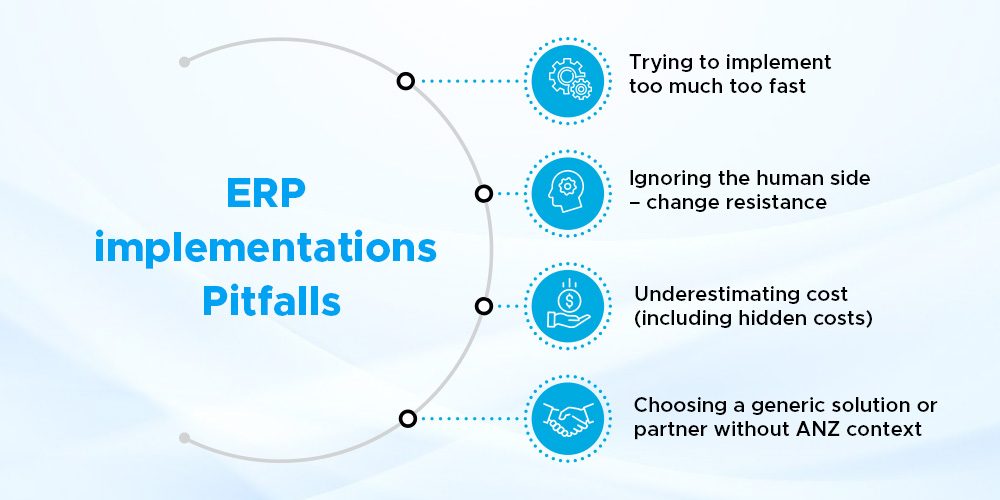
Even with the right platform, many ERP implementations fail to deliver expected value.
Here are common pitfalls and how ANZ SMEs can avoid them.
1. Pitfall: Trying to implement too much too fast
When organizations attempt to roll out every module at once (finance, inventory, service, HR), they often end up with over-complexity, budget blowouts, or poor adoption.
One article on Australian SMEs warned that many only use 40–60 % of the features they pay for.
Avoidance Tip: Start with core functions that deliver value now, then phase in additional modules as the business is ready.
2. Pitfall: Ignoring the human side – change resistance
Technology is only one part of the solution. People, culture, training, and change management of ten determine success. The Australian SME ERP research identifies a lack of leadership commitment and skilled resources as major barriers.
Avoidance Tip: Ensure you have a change-management plan: communicate clearly why you’re doing this, invest in training, involve staff early, and celebrate wins.
3. Pitfall: Underestimating cost (including hidden costs)
ERP implementation costs are not just software licenses. In Australia, SMEs may face licensing, development/customization, implementation/integration, training, and ongoing support.
Avoidance Tip: Build a realistic budget with all cost elements. Plan for ongoing costs (support, upgrades) and define metrics to measure ROI.
4. Pitfall: Choosing a generic solution or partner without ANZ context
Global ERP systems often don’t account for local compliance, hybrid work models, or remote/regional operations typical in Australia & New Zealand. One article emphasized the need for local partner knowledge.
Avoidance Tip: Choose a partner who knows the ANZ market, understands GST/BAS, payroll rules, hybrid workforce issues, and local operational realities.
Metrics and Evidence: What Success Looks Like
- In the referenced Forrester study of Dynamics 365 Business Central implementations, businesses reported avoiding one full-time equivalent (FTE) plus one part-time equivalent hire in finance & operations over three years, improved workflows by an average of 8 % and eliminated US $44k of third-party reporting spend.
- Cloud-ERP adoption among Australian SMEs is expected to reach ~75 %, showing strong market momentum and supporting the case for cloud-first ERP strategies.
- One particular Australian review of ERP usage found many SMEs use only 40–60 % of the features they pay for, highlighting the importance of prioritizing modules and value-driven approaches.
- A study of ANZ SMEs found 93 % of them consider technology fundamental to their success, and 76 % plan to apply AI in marketing for 2026.
These metrics show that not only is the environment ripe for ERP adoption for ANZ SMEs, but the measurable outcomes (efficiency, cost-avoidance, productivity) are within reach when implementation is done well.
Roadmap for ANZ SMEs: From Decision to Value

Here’s a high-level roadmap tailored for SMEs in Australia & New Zealand considering Dynamics 365 Business Central:
1. Strategic Alignment
- Engage leadership and define business goals (e.g., “reduce month-end close time by 30 %”, “improve cash-flow visibility”, “enable multi-location remote team access”).
- Map current pain points and opportunities (e.g., manual reconciliations, disconnected systems, compliance risk).
2. Vendor & Partner Evaluation
- Identify partners with ANZ experience in ERP, Microsoft ecosystem, and hybrid/remote implementations.
- Confirm understanding of local tax/regulation/ payroll/GST/BAS requirements.
- Review reference cases from Australian SMEs and check user-adoption stories.
3. Scoping & Prioritization
- Identify core modules for the first phase (finance & operations, procurement, basic inventory).
- Define longer-term modules (CRM, service, warehouse/production) in a roadmap.
- Agree on key success metrics (efficiency, cost savings, user adoption, data accuracy).
4. Data & Process Preparation
- Map existing processes end-to-end (from lead to cash, purchase to pay, supply-chain to deliver).
- Cleanse and migrate key data (GL, AR/AP, inventory, customer/supplier records).
- Engage teams early to drive change-readiness and training plans.
5. Implementation & Go-Live
- Pilot in a small scope or single location if feasible.
- Configure modules, test thoroughly (data, workflows, integrations).
- Train users, run change management activities (town halls, champions, feedback loops).
- Go-live with monitoring, support, and immediate feedback mechanisms.
6. Post-Go-Live Review & Optimization
- Monitor key metrics: system adoption, productivity changes, cost avoidance.
- Review “what went well”, “what needs improvement”.
- Expand modules incrementally (e.g., service, warehouse, advanced analytics).
- Build a continuous improvement culture: refine processes, add features only when value-driven.
Humanizing the Journey: Leadership, Culture & People
It’s tempting to treat an ERP implementation purely as a technology or finance project. But in reality, the human side matters just as much — if not more. Here are some reflections to keep your story human, relatable, and lasting:
- Tell the people’s story– For the SME owner in Melbourne, the warehouse manager in regional NSW, or the operations lead in Auckland, implementing a new ERP means change. Acknowledging their concerns (about change, training, job roles) builds trust.
- Celebrate early wins– A quick win like “we now close the month in three fewer days” or “remote team in Perth can now access live dashboards from home” builds momentum and belief.
- Make users champions– Identify early adopters and bring them into the process. Let them share successes, help peers,and act as internal advocates.
- Link technology to purpose– For many ANZ SMEs, success isn’t just profit; it’s delivering service, supporting community, enabling staff to work flexibly. Relate technology to those bigger-picture goals.
- Learning is ongoing – Rolling out an ERP isn’t a one-time “install and forget”. It’s about evolving how your business works, how people collaborate, and how decisions are made. Embrace that mindset.
Looking Ahead: Why This Matters for 2026 and Beyond
As we move through 2025 and into the next decade, several trends underscore why implementing Dynamics 365 Business Central now is not just timely but strategic:
- Hybrid & remote work has become embedded in ANZ business models. ERP systems must support flexible access, multi-location teams, and varied devices.
- Data-driven decision-making is no longer “nice to have”—it’s expected. SMEs that can pull real-time insights will have an edge.
- Regulatory change, cost pressures and supply-chain shocks remain constant. A modern ERP provides resilience through flexibility, audit trails and better forecasting.
- Scaling for growth means being ready for expansion—new products, new markets, new channels. Cloud ERP, like Business Central, supports that.
- Competitive differentiation—many ANZ SMEs are digital-native and tech-savvy. Having a modern underlying system enables them to compete not only locally but globally.
The message is clear: For ANZ SMEs, implementing Dynamics 365 Business Central is more than just “adopting new software” — it’s positioning your business for growth, agility and survival in a changing world.
Conclusion
When Australian and New Zealand SMEs invest the time, thought, and leadership required to implement Dynamics 365 Business Central well, the rewards can be significant: better visibility, stronger decision-making, cost-control, scalability, and future-readiness.
But success isn’t automatic. It comes from clarifying the why, partnering with the right people, prioritizing the right features, managing change thoughtfully, and keeping your people at the heart of the process.
If your business in the ANZ region is ready to move beyond “keeping the lights on” to “leading the pack”, then exploring how Dynamics 365 Business Central can work for you is a smart, strategic, and timely conversation to have.
Business Central Implementation Across Australia
If you’re planning to align your ERP strategy with the latest Microsoft Business Central roadmap, working with the right local experts can make a real difference. From planning to execution, having region-specific support helps ensure smoother implementation and better long-term results.
Our team supports businesses across major Australian cities with tailored Business Central solutions:
Business Central Implementation in Sydney
Business Central Implementation in Melbourne
Business Central Implementation in Perth
Business Central Implementation in Brisbane
Whether you’re exploring ERP adoption or preparing for future upgrades, working with experienced Business Central consultants can help you move forward with clarity and confidence.
Connect with our experts to explore the right approach for your business.
Categories
- Implementation
- Dynamics Business Central
- Dynamics 365
- Construction365
- Australia
- Artificial Intelligence
- AI Agents in Business
Recent Posts
- AI Agents in Microsoft 365 Copilot: The Future of Intelligent Business Automation
- Price Hiked, Value Locked: The Guide to Business Central Pricing in Australia
- Stop Paying the “On-Prem Tax”: Why Australian SMEs are Pivoting to Business Central SaaS in 2026
- Business Central vs. Xero: The 2026 Decision Guide for Australian Businesses
- Wasting Millions on “Fake” AI: The 2026 Australian Construction Reality Check