

Blog
Why Construction Firms Must Act Now as Dynamics GP Becomes a Cybersecurity and Operational Liability
Written by
Bruce Scott /  February 12, 2026


The cyber threats facing construction companies show no signs of slowing. In 2024 alone, 481 construction organizations appeared on ransomware data-leak sites; a 41% year-over-year increase. That surge has turned cybersecurity from a back-office IT concern into a front-line business risk affecting cash flow, project timelines, and hard-earned reputations.
At the same time, many firms still rely on legacy systems like Microsoft Dynamics GP, even as Microsoft has placed it on a fixed end-of-support path. But the greatest danger isn’t that GP suddenly stops working. The real risk is that it continues running quietly in the background while security exposure, maintenance costs, and operational inefficiencies steadily grow.
Forward-thinking construction leaders recognize this shift.They’re starting ERP strategy conversations now while they still control the timing, budget, and level of disruption, rather than waiting for a security incident, compliance issue, or system failure to force the decision.
Let’s look at why the urgency is increasing.
- Why Dynamics GP is Becoming a Cybersecurity Liability
- Why Are Operational Risks Rising Even If Microsoft Dynamics GP Still “Works”
- Microsoft’s Dynamics GP Timeline: What Construction Firms Need to Know
- Why Business Central is the Strategic Upgrade for Construction
- Why Migration Timing Matters Now: Microsoft Funding Is Limited
- Final Thoughts
- FAQs
Why Dynamics GP is Becoming a Cybersecurity Liability
Construction companies have become prime targets for ransomware and cybercrime. The reason is simple: construction firms manage high-value financial and operational data across multiple external parties.
Legacy Security Architecture
Microsoft Dynamics GP for Construction was built long before modern cybersecurity standards like identity-based access controls, automated threat detection, and real-time monitoring became essential. It lacks many of the native protections modern cloud platforms are built around.
Limited or Ending Security Patches Increase Exposure
As Microsoft shifts its investment and innovation toward cloud ERP solutions like Dynamics 365 Business Central, legacy platforms such as Dynamics GP are no longer evolving from a security perspective.
Microsoft has set a firm end-of-support roadmap for GP, with mainstream updates ending in December 2029 and final security patches ceasing by April 2031, which means future threats will increasingly outpace defensive improvements for the product.
In September 2025, Morrisroe Ltd, a construction firm, reported a significant cyber incident that exposed sensitive company data. This incident highlights that even established construction firms are vulnerable to modern cyber threats. So how can older ERP systems keep pace with today’s security demands?
Source – Construction News
On-premises Environments Strain Security Controls
Most GP environments rely on on-premises servers, which depend on:
- Manual patching
A team of IT experts is required to implement the Dynamics GP updates. However, in construction firms, they have limited resources, which results in delayed or skipped patches, leaving the system exposed to attackers.
- Aging servers
Many construction companies run Microsoft Dynamics GP on old servers, and they aren’t just costly to maintain but demand robust security, too. Therefore, hardware failures or outdated operating systems can lead to unexpected downtime, impacting project timelines and cash flow.
- Limited monitoring
On-prem systems usually lack 24/7 security monitoring. Attacks may go unnoticed until damage is already done, such as locked files or halted payments.
Why Are Operational Risks Rising Even If Microsoft Dynamics GP Still “Works”
A common response from finance leaders is: “GP still runs fine. Why change now?” The answer lies in the hidden operational costs that compound over time.
Shrinking Dynamics GP Expertise
As the ERP market shifts to cloud platforms, fewer consultants and developers specialize in GP. This leads to:
- Longer support wait times
- Higher consulting costs
- Increased dependency on a shrinking talent pool
For finance teams pushing for faster closes and better visibility, delays in resolving issues directly impact decision-making.
Growing Customization Burden
Many construction firms have added layers of custom reports, third-party tools, and workarounds to make GP meet evolving needs. Over time, these customizations become:
- Expensive to maintain
- Difficult to upgrade
- Risky when key knowledge holders leave
Each additional workaround increases system complexity and operational fragility.
The High Cost of Emergency Migrations
When modernization is delayed too long, change is often triggered by a crisis:
- Server failure
- Security incident
- Audit finding
- Compliance gap
Emergency migrations are rushed, more expensive, and far more disruptive to projects and financial operations than a planned transition.
Microsoft’s Dynamics GP Timeline: What Construction Firms Need to Know
Microsoft has officially outlined when Dynamics GP support, licensing, and expansion options will end, and it’s a wind-down path. Let’s have a look:
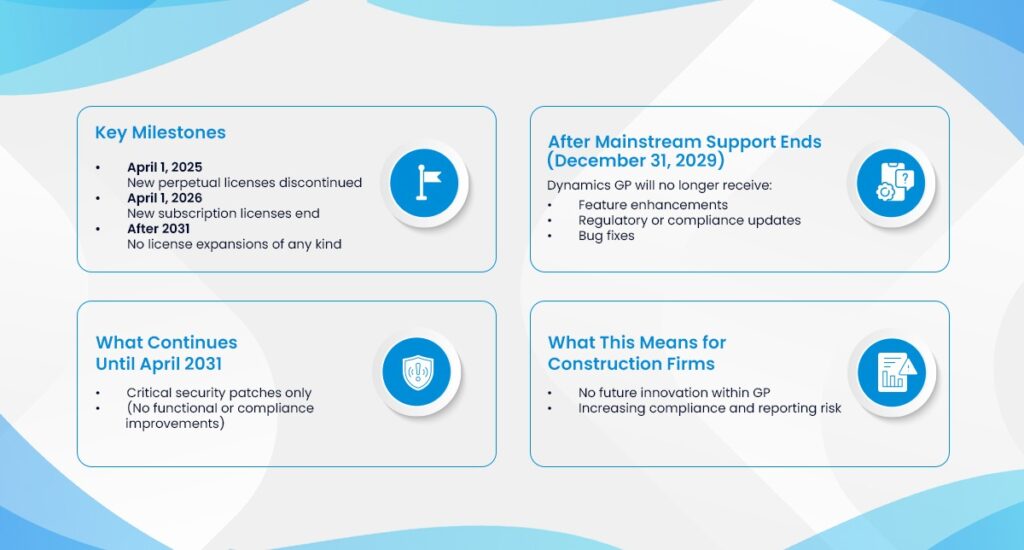
Hence, Dynamics GP has entered its maintenance-only phase, making it unsuitable for long-term growth, compliance, or modernization.
Why Business Central is the Strategic Upgrade for Construction
Today’s construction firms require a strategic upgrade from Dynamics GP to Dynamics 365 Business Central. Here’s why:
Built-in cloud security, backed by Microsoft
Dynamics 365 Business Central is developed on a security-first approach. It’s a cloud-based ERP solution, which means security no longer relies on old servers or manual patches.
Moreover, Business Central offers various comprehensive security features, such as:
- Enterprise-grade encryption
- Multifactor authentication
- Continuous security monitoring
- Automatic threat detection and response
For construction firms managing payroll, subcontractor payments, and job cost data, this significantly reduces exposure to ransomware and data breaches.
Continuous Updates Without Disruption
Unlike GP, Dynamics 365 Business Central receives monthly updates, including security improvements, solution performance enhancements, and compliance changes. Construction companies can focus on their projects rather than fearing unpredictable downtime or expensive upgrade projects.
No on-prem servers or patching overhead
With Business Central, there’s no need to manage physical servers, backups, or manual patching. This removes a major IT and operational burden, especially valuable for construction firms that operate across multiple job sites and lean IT teams.
Connected Finance, Jobs, Field Operations, and Analytics
Business Central strongly supports the core requirements for construction businesses, such as detailed job costing, project-based financials, budget vs. actual tracking, and real-time analytics. With this solution, construction firms gain better visibility on cash flow, control over margins, and project profitability.
Seamless Integration with the Microsoft Ecosystem
Business Central works naturally with the tools construction teams already use:
- Power BI for visual, real-time financial, and job reporting
- Microsoft 365 (Excel, Teams, Outlook) for collaboration
- Field operations and analytics tools to connect office and job-site data
- Microsoft Copilot & AI capabilities embedded within Business Central to automate routine tasks, surface insights, predict cash flow trends, and improve decision-making
This eliminates manual data transfers and disconnected systems.
Additional Construction-Specific Business Value:
For construction firms, these capabilities translate into real operational benefits:
- Better financial visibility across jobs
Leadership can see job performance, cash flow, and costs across projects in real time, not weeks later.
- Real-time reporting for faster decisions
Project managers and finance teams can identify cost overruns, delays, or margin risks early, when they’re still fixable.
- Scalability for growing and multi-entity firms
Whether expanding into new regions, adding entities, or taking on larger projects, Business Central scales without the complexity and limitations of legacy systems.
Why Migration Timing Matters Now: Microsoft Funding Is Limited
Microsoft has launched a Business Central Migration Voucher program to help Dynamics GP customers offset migration and implementation costs when moving to Dynamics 365 Business Central. The offer runs from July 15, 2025, through June 30, 2026.
Vouchers are available on a first-come, first-served basis and must be redeemed within a set window after issuance. Construction firms that delay planning risk missing out on this financial support entirely.
Acting now helps organizations reduce migration costs, avoid a last-minute rush, and plan the transition on their own timeline instead of being pressured by limited funding windows or support deadlines.
Final Thoughts
For construction firms running Dynamics GP, the question is no longer if change is needed, but when. Rising cybersecurity risks, increasing operational costs, and Microsoft’s fixed support timeline are rapidly narrowing the window to act.
Dynamics 365 Business Central offers a secure, scalable path forward built for modern construction operations. Firms that move early can lower migration costs by securing limited Microsoft funding, avoiding last-minute pressure, and transitioning on their own terms while positioning themselves for long-term growth.

FAQs
Rising cybersecurity exposure, higher maintenance costs, shrinking Dynamics GP expertise, and increasing compliance challenges can all impact financial performance and operational continuity.
No. However, mainstream support for Dynamics GP ends in 2029, with only limited security updates available afterward. Innovation and regulatory updates are already slowing.
Modern cloud ERP platforms offer stronger security, automatic updates, real-time job costing visibility, and seamless integration across finance, operations, and field teams.
Delaying migration planning often leads to higher costs, missed funding opportunities, and rushed transitions triggered by system failures or compliance risks.
Begin with a structured ERP risk and readiness assessment to understand your exposure, define priorities, and create a migration timeline aligned with business goals.
Categories
- United Arab Emirates
- Microsoft Dynamics 365 Finance and Operations
- Dynamics Business Central
- Dynamics 365
- Construction365
- Artificial Intelligence
Recent Posts
- Top Business Central Features Middle East SMEs Are Using to Pull Ahead
- Retail at the Speed of Now: Overcoming Legacy Limits with D365 Finance & Supply Chain Management
- Getting Real Value from Dynamics 365 F&SCM: Smart ROI Strategies for UAE Retail Businesses
- Beyond Out-of-Stock: The Real Cost of “Blind” Inventory for UAE Retail Brands
- How AI Agents in Microsoft Dynamics 365 Finance & Supply Chain Management Are Transforming Retail Margins