

Blog
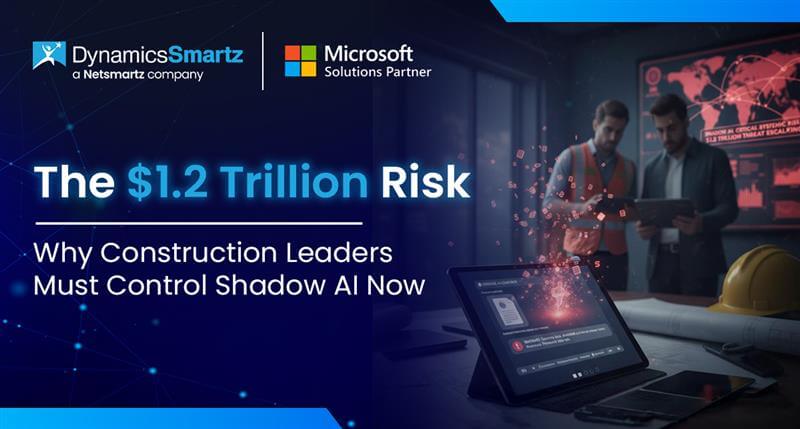
The $1.2 Trillion Risk: Why Construction Leaders Must Control Shadow AI Now
Written by
Tim Tucker /  April 2, 2026


Summary
Construction teams are already using AI. The issue isn’t adoption, it’s visibility. When employees work outside approved systems, Shadow AI risk increases and bid data, margins, and client information can be exposed without leadership realizing it. This blog explains where that risk appears and how to regain control without slowing teams down.
Construction firms are rapidly experimenting with artificial intelligence to improve productivity across estimating, project management, and jobsite operations. But inside many organizations, AI adoption is happening without leadership visibility.
Estimators are uploading bid spreadsheets to AI tools to analyze pricing. Project managers are sharing cost forecasts with AI assistants. Engineers are uploading jobsite photos for safety analysis.
When these actions occur outside approved systems, they create a growing risk known as Shadow AI.
The risk is already measurable. According to IBM’s Cost of a Data Breach Report, 1 in 5 organizations have experienced a breach linked to Shadow AI, and those incidents increase breach costs by an average of $670,000.
At the same time, governance is lagging behind adoption. Research shows 63% of organizations still lack formal AI governance frameworks, leaving teams to experiment with AI tools without structured oversight.
So, what begins as convenience can quickly become operational disruption.
What Shadow AI Looks Like in Construction
Various instances of shadow AI are happening in construction firms without the IT team’s knowledge.
-
Uploading sensitive cost data to public AI tools like ChatGPT is often done to compare labor rates, analyze vendor agreements, optimize bids, or review subcontractor pricing.
At first, it may seem harmless, but it can expose sensitive strategic information and lead to NDA violations, legal liabilities, and potential loss of bids. -
Sharing the job budget spreadsheet with AI tools without governance is often done to optimize job costs, forecast cost-to-complete, identify overruns, or improve margins.
While it may feel efficient, it can expose margin visibility, compromise proprietary financial data, and leave no governed audit trail. -
Job site images are sometimes uploaded to public AI tools to identify safety risks, pinpoint construction defects, or verify whether installations are correct.
Using AI as a second pair of eyes seems helpful. But it can also leave a trail of evidence that can be used in construction defect litigation or worker’s compensation litigation.
Why Construction is More Exposed Than Other Industries
Despite heavy investment in AI, only 37% businesses have incorporated this technology into their workflows. However, 73% of companies are still struggling to leverage the advantages of digital transformation. They’re relying on legacy systems for project management, finance, and job site operations.
It means:
- Disconnected systems
- Poor oversight
- Blind spots in operations
When leadership is reluctant to adopt new technologies, employees often turn to unsanctioned AI to fill gaps, boosting productivity while bypassing governance.
The result? Uncontrolled AI tool usage and escalating Shadow AI risk across projects.
AI Productivity vs. Risk Dilemma
AI can boost construction productivity, but unmonitored use creates operational gaps.
Where AI adds value:
- Bid analysis: model costs and compare pricing quickly
- Schedule reviews: detect delays or bottlenecks early
- Photo insights: spot site issues, hazards, or defects
- RFIs and change orders: streamline approvals and communication
The challenge: Teams may adopt AI for convenience without structured workflows, creating inconsistent processes, and blind spots.
The solution: The goal is not to stop AI, but to train employees on the appropriate usage and risks, while governing and securing it.
To address these challenges safely and maintain productivity, construction firms need a secure AI companion embedded within systems.
How Microsoft Copilot Secures Productivity
Construction teams need AI to gain efficiency, but only if it is secure, governed, and reliable. That is where Microsoft Copilot comes in.
- AI embedded in your workflow: Copilot is built into Microsoft solutions like Dynamics 365 Business Central, Dynamics 365 Finance & Supply Chain Management, and Dynamics 365 CRM. As a result, teams get insights and automation within a controlled, enterprise environment.
- Built-in governance and controls: IT teams can manage Copilot usage through centralized admin tools. In addition, they get full visibility into how AI is used. Data loss prevention policies, restricted connectors, and environment-level controls help protect sensitive projects and financial data.
- Controlled access and sharing: Administrators can define who can create, publish, and share Copilot agents. Moreover, solutions can be reviewed and certified before wider access. This reduces the risk of uncontrolled AI usage.
- Security, compliance, and auditability: Copilot integrates with Microsoft Purview for sensitivity labeling and audit logging. Therefore, all AI interactions are tracked and aligned with organizational policies.
- Guided and responsible adoption: Built-in recommendations, onboarding guidance, and security checks support users at every stage. This ensures teams use AI effectively while staying within governance standards.
Where this matters for construction:
Copilot becomes even more powerful when applied within construction-specific workflows. When integrated with purpose-built construction management solutions like ProjectPro on Dynamics 365 Business Central, it can surface real-time insights across job costing, project performance, and financials.
This helps teams make faster, more informed decisions while improving speed, automation, and security across operations.
Microsoft also provides supportive governance tools such as Purview, Entra, Defender for Cloud Apps, and Intune to complement secure AI adoption.
Don’t let unmanaged AI compromise your workflows. Let’s connect to see how Microsoft Copilot can help.
FAQs
Shadow AI refers to employees using AI tools outside IT oversight or governance policies. In construction, this often includes uploading bids, budgets, or jobsite data to public AI platforms. As a result, firms risk data leaks, NDA violations, and loss of control over sensitive information.
Construction firms rely heavily on project data such as cost estimates, subcontractor pricing, and margins. When unmanaged AI tools are used, this information can be exposed externally. Consequently, firms face risks like data breaches, compliance issues, and loss of competitive advantage.
Yes, but only when it is implemented within a governed environment. AI tools embedded in enterprise platforms allow teams to generate reports, analyze schedules, and automate workflows securely. This ensures productivity gains without exposing sensitive construction data.
Microsoft Copilot integrates AI directly into business applications, keeping data within the enterprise ecosystem. In addition, IT teams can enforce governance through access controls, data policies, and audit capabilities. This eliminates the need for external AI tools and reduces the risk of unmanaged usage.
Firms should adopt AI within controlled platforms, enforce data governance policies, and monitor usage across systems. They should also guide employees on approved tools and regularly audit activities. Together, these steps help maximize productivity while minimizing Shadow AI risks.
Categories
- United Arab Emirates
- Retail
- Microsoft Dynamics 365 Finance and Operations
- Finance and Operations
- Dynamics Business Central
- Dynamics 365
- Construction365
- Artificial Intelligence
Recent Posts
- Frontier Transformation in Retail: When AI Moves from Insight to Action
- Top Business Central Features Middle East SMEs Are Using to Pull Ahead
- Retail at the Speed of Now: Overcoming Legacy Limits with D365 Finance & Supply Chain Management
- Getting Real Value from Dynamics 365 F&SCM: Smart ROI Strategies for UAE Retail Businesses
- Beyond Out-of-Stock: The Real Cost of “Blind” Inventory for UAE Retail Brands